Philippines ⇄  Compare
Country Profile

Philippines flag Philippines

The Philippines, officially the Republic of the Philippines, is an archipelagic country in Southeast Asia.
ISO PHL · PH  ·  Region Asia  ·  Figures for 2024

Key Statistics

World Bank · 2024

Geography & Terrain


Satellite · Mapbox
Physical terrain of Philippines.
Political · Mapbox
Political boundaries, neighbours and principal cities.
View the Philippines population-density map →

Health System


Health Outcomes
22.1
per 1,000 live births
84.0
per 100,000 live births
Spending & Access
System Capacity
0.8
per 1,000 people
4.8
per 1,000 people
1.0
per 1,000 people
Preventive Care
71.0%
children 12–23 mo.
80.0%
children 12–23 mo.
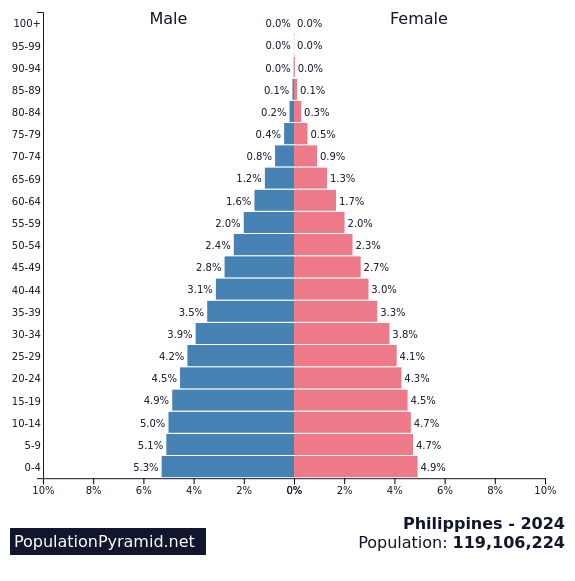
Age Structure
Distribution by age and sex, 2024.Source: PopulationPyramid.net

Economy


GDP composition by sector.Source: World Bank
Trade balance, % of GDP.Source: World Bank
Composition of goods exports, 2022.Source: OEC
Composition of goods imports, 2022.Source: OEC

Education


Society & Equality


Technology & Infrastructure


Historical Trends


Population, 1960–2024.
Gross domestic product, US$.
Life expectancy at birth.

About Philippines


The Philippines, officially the Republic of the Philippines, is an archipelagic country in Southeast Asia. Located in the western Pacific Ocean, it consists of 7,641 islands, with a total area of roughly 300,000 square kilometers, which are broadly categorized in three main geographical divisions from north to south: Luzon, Visayas, and Mindanao. With a population of over 112 million, it is the world's fourteenth-most-populous country.

Source: Wikipedia

Detailed Map


Cities, roads and terrain of Philippines.Source: Geoapify · OSM

Population Density


Modelled population density, by 1 km cell.Source: WorldPop
View the detailed population density page for Philippines →