Germany ⇄  Compare
Country Profile

Germany flag Germany

Germany, officially the Federal Republic of Germany, is a country in Western and Central Europe.
ISO DEU · DE  ·  Region Europe  ·  Figures for 2024

Key Statistics

World Bank · 2024

Geography & Terrain


Satellite · Mapbox
Physical terrain of Germany.
Political · Mapbox
Political boundaries, neighbours and principal cities.
View the Germany population-density map →

Health System


Health Outcomes
3.1
per 1,000 live births
4.0
per 100,000 live births
Spending & Access
System Capacity
4.5
per 1,000 people
12.2
per 1,000 people
7.5
per 1,000 people
Preventive Care
89.0%
children 12–23 mo.
96.0%
children 12–23 mo.
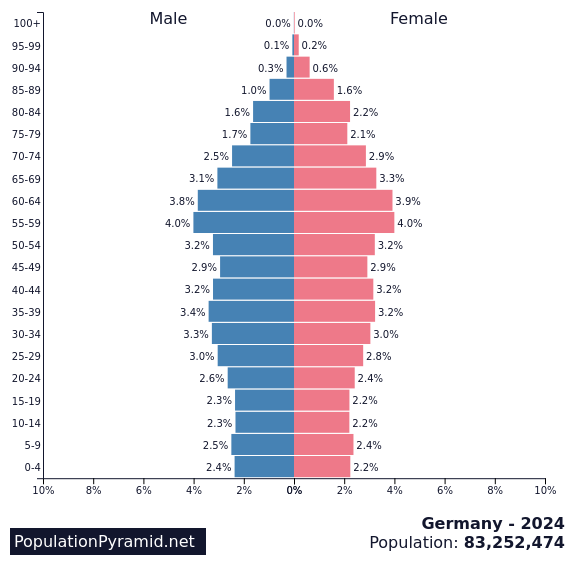
Age Structure
Distribution by age and sex, 2024.Source: PopulationPyramid.net

Economy


GDP composition by sector.Source: World Bank
Trade balance, % of GDP.Source: World Bank
Composition of goods exports, 2022.Source: OEC
Composition of goods imports, 2022.Source: OEC

Education


Society & Equality


Technology & Infrastructure


Historical Trends


Population, 1960–2024.
Gross domestic product, US$.
Life expectancy at birth.

About Germany


Germany, officially the Federal Republic of Germany, is a country in Western and Central Europe. It lies between the Baltic Sea and the North Sea to the north with the Alps to the south. Its sixteen constituent states have a total population of over 82 million, making it the most populous member state of the European Union. Germany borders Denmark to the north; Poland and the Czech Republic to the east; Austria and Switzerland to the south; and France, Luxembourg, Belgium, and the Netherlands to the west. The nation's capital and most populous city is Berlin and its main financial centre is Frankfurt; the largest urban area is the Ruhr.

Source: Wikipedia

Detailed Map


Cities, roads and terrain of Germany.Source: Geoapify · OSM

Population Density


Modelled population density, by 1 km cell.Source: WorldPop
View the detailed population density page for Germany →